
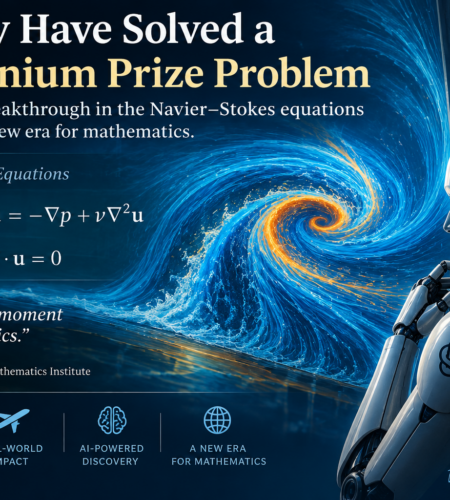
OpenAI says its experimental A.I. system has found a solution to the Navier–Stokes problem. For generations, mathematicians have struggled with a fundamental question about the Navier–Stokes equations, which describe fluid motion.
Can a fluid that begins perfectly smoothly develop a singularity: a point where its velocity becomes infinite in finite time? On Sept. 8, OpenAI said the answer is yes.
The company announced that an experimental A.I. system had produced a proof showing that such a breakdown can occur. If the proof survives mathematical scrutiny, it would resolve one of the seven Millennium Prize Problems, established by the Clay Mathematics Institute in 2000 and carrying a $1 million prize.
The result is remarkable not only because of the problem, but because of how it was found. OpenAI says it deployed roughly 10,000 A.I. agents to work on Navier–Stokes, concentrating an extraordinary amount of computational effort on a single mathematical question.
A Mathematical Race
The announcement came amid an unusual burst of progress. Nature reported that OpenAI intensified its work after hearing that mathematicians Levent Alpöge and Tristan Buckmaster had made progress on a related problem using A.I. systems. They soon released work on the zero-viscosity version of the fluid equations. Another group, led by Anima Anandkumar, independently reported progress using physics-informed neural networks.
In a matter of days, several groups using different forms of A.I. had converged on problems that mathematicians had studied for generations. The circumstances have also prompted debate. Terence Tao praised the related mathematical progress but questioned the growing practice of announcing major results through press releases and social media before they have moved through mathematics’ traditional channels of preprints, seminars, and peer review.
That caution matters. The Clay Mathematics Institute requires a proposed solution to be published and undergo extensive evaluation before it can be formally recognized. So, for now, the careful conclusion is that OpenAI says it has solved the Navier–Stokes problem. Whether the proof is ultimately accepted remains to be seen.
But something important may already have changed. For years, A.I. in mathematics was largely viewed as a tool for calculation, experimentation, and proof assistance. Now we may be entering a period in which machines participate directly in discovering mathematics at the research frontier.
AI is rapidly moving from being a tool that helps us learn mathematics to a collaborator that may help us discover mathematics.
Perhaps the most interesting question is no longer simply: “Can AI do mathematics?”
It may now be: “What mathematics will humans and AI discover together?”
Here is the preprint: https://cdn.openai.com/pdf/32d9f210-8b73-45e0-91bc-82a30aef8a9a/navier-stokes.pdf
Reference: https://www.nature.com/articles/d41586-026-02842-5
Comments